Hot Keywords:
You may be looking for ..
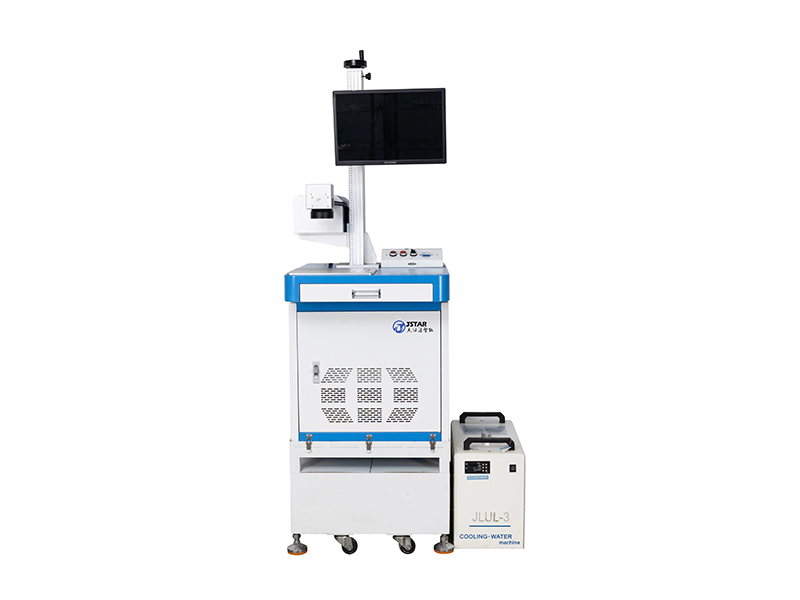
Fiber laser machines mainly use fiber lasers as light sources, which are laser equipment commonly used for metal engraving and plastic engraving. The core of fiber lasers refers to lasers that use rare earth element-doped glass fibers as gain media. Fiber lasers can be developed based on fiber amplifiers: under the action of pump light, high power density is easily formed in the fiber, causing "population inversion" of the laser energy levels of the laser working material. When appropriate positive feedback loops (forming resonant cavities) are added, laser oscillation output can be formed.
Fiber laser machines use glass solid fibers drawn from SiO2 as the matrix material. Their light guiding principle utilizes the principle of total internal reflection, that is, when light enters from an optically dense medium with a large refractive index to an optically thin medium with a small refractive index at an angle greater than the critical angle, total internal reflection will occur, and all incident light will be reflected back to the optically dense medium with a large refractive index, with no light transmitted through the optically thin medium with a small refractive index. Ordinary bare optical fibers generally consist of a central high-refractive-index glass core, an intermediate low-refractive-index silica glass cladding, and an outermost reinforced resin coating. Optical fibers can be divided into single-mode fibers and multi-mode fibers according to the propagation light wave mode. Single-mode fibers have smaller core diameters and can only propagate one mode of light, with smaller intermodal dispersion. Multi-mode fibers have thicker core diameters and can propagate multiple modes of light, but their intermodal dispersion is larger. According to the refractive index distribution, they can be divided into step-index (SI) fibers and graded-index (GI) fibers.
Taking rare earth-doped fiber lasers as an example, the fiber core doped with rare earth ions serves as the gain medium, and the doped fiber is fixed between two mirrors to form a resonant cavity. Pump light enters the fiber from M1 and outputs laser from M2. When pump light passes through the fiber, rare earth ions in the fiber absorb the pump light, and their electrons are excited to higher excited energy levels, achieving population inversion. The inverted particles radiate from high energy levels to the ground state, outputting laser.
Previous Chapter:Maintenance and Care of Air Compressors in Laser Cutting Machines
Next Chapter:How to Choose a UV Laser Marking Machine?